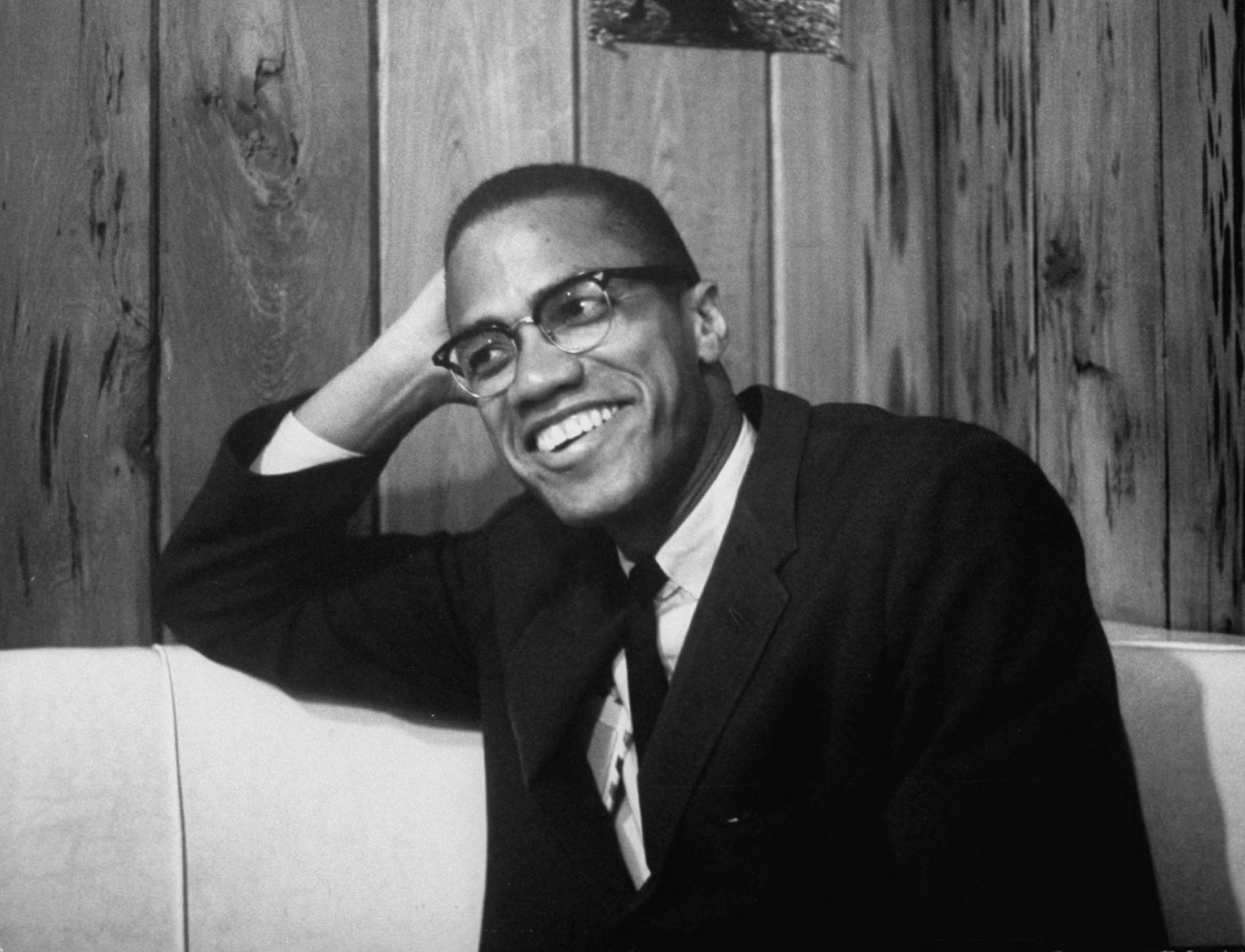
On May 19, 2025, we commemorate the 100th birthday of el-Hajj Malik el-Shabazz, most commonly known as Malcolm X. A visionary leader before his tragic assassination in 1965, X’s legacy continues to inspire people facing social injustice across the globe. His story and words have left a powerful testament explored in many books, films, and documentaries since his passing.
I was about ten when my dad showed me a copy of The Autobiography of Malcolm X and said it was a book that every Black man should read. I immediately tried to dive into it but was too young to comprehend the text and grapple with the depth of subjects that arise in the book. It wasn't until high school and again in college, that I was able to really sit with The Autobiography of Malcolm X. The autobiography, co-written with Alex Haley and posthumously released in 1965, is considered the most comprehensive account of X's life. It takes readers from X's childhood in Michigan to his rise as one of the world's most influential figures in the 1960s. The vivid first-person narration brings readers into the perspective of X at these different points in his life. I've heard many people describe the impact The Autobiography of Malcolm X had on them. One common theme described is the drastic transformation that occurs from X's life as a street hustler to his leadership role in the Nation of Islam, departure from the organization, and pilgrimage to Mecca.
Through X's story, we see the pain that is both necessary for and often a product of growth. For example, X's imprisonment led to his embarkment on a quest for knowledge and spiritual transformation. In college, an English professor of mine assigned reading from an excerpt of The Autobiography of Malcolm X titled, "Learning to Read". In the excerpt, X describes teaching himself to read in prison by copying from a dictionary. He states, "I could for the first time pick up a book and read and now begin to understand what the book was saying. Anyone who has read a great deal can imagine the new world that opened... In fact, up to then, I never had been so truly free in my life." From this brief but powerful quote, we see the significant shift in X's outlook during that time. As much as we learn about the positive aspects of transformation in X's life, The Autobiography of Malcolm X also recounts the resistance he faced separating from the organization that changed his life and in which he changed the lives of countless others. As X separated from the Nation of Islam, he faced hostile intimidation and remained a controversial figure in the mainstream press. Despite a more universal lens and willingness to work with leaders across organizations, X faced backlash for speaking truth to power.
On the 100th birthday of Malcolm X, we have an opportunity to celebrate and reflect on the legacy of a man that continues to be felt 60 years after his passing. As a leader, he fearlessly advocated for the causes of his people at a time when society relegated their sufferings to the margins. He demonstrated a journey of self-transformation that inspires people overcoming incarceration, addiction, and other struggles. Anytime I hear one of his speeches or interviews, the conviction in his voice alone inspires me to lead a life of purpose. Malcom X consistently spoke his truth no matter how uncomfortable that truth made others feel. We can only imagine what further impact Malcolm X would have made had his life not been tragically cut short at age 39. What's for certain, is that there is a lot to be learned from the life and legacy he left behind. Let us continue to uphold the memory of Malcom X and other leaders whose powerful life stories can enrich our own.

